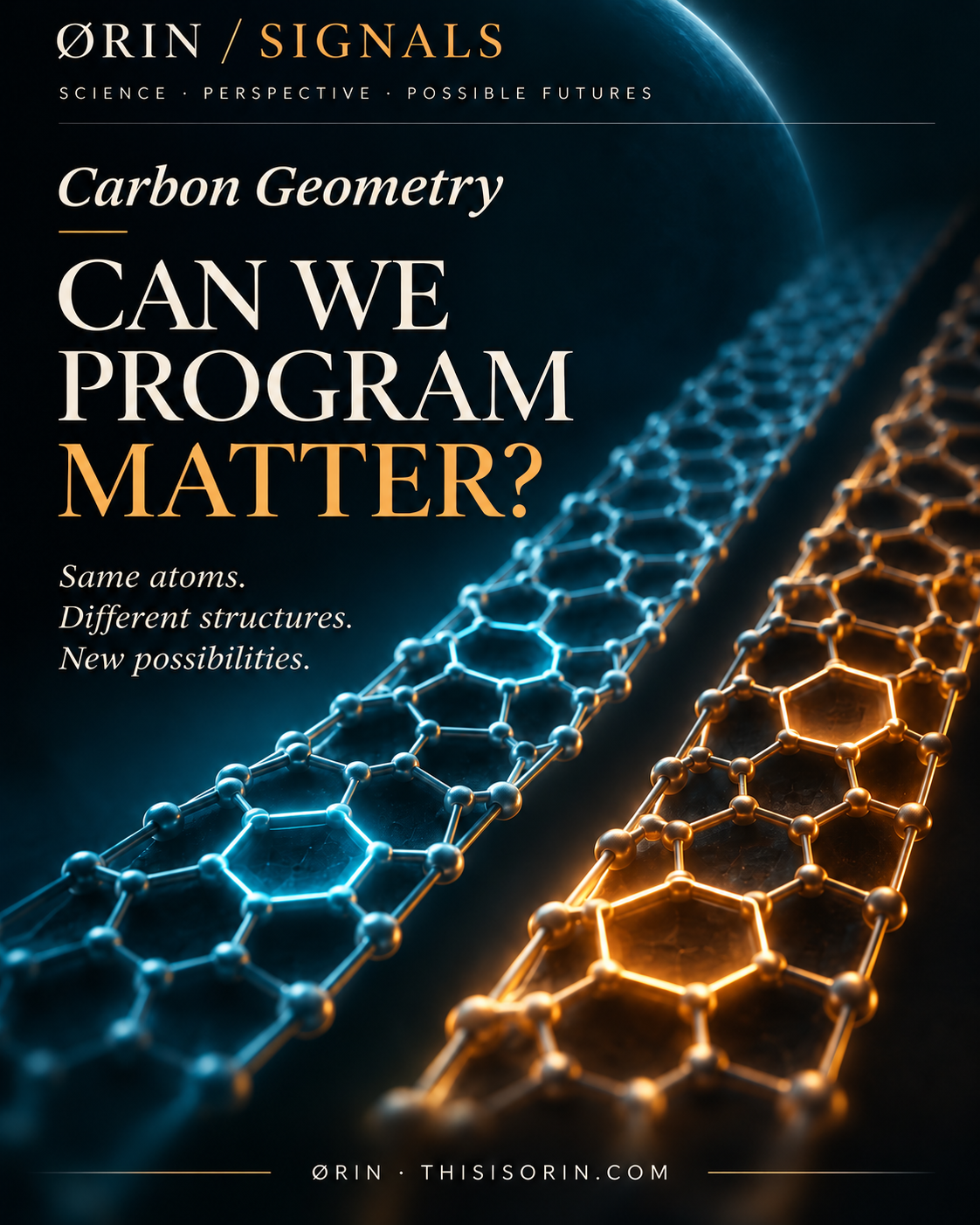
Artistic interpretation — ØRIN. Inspired by Huang et al., Nature (2026); not an experimental image or an exact atomic model.
Same element. Different architecture. A different electronic world.
Two ribbons, both made entirely of carbon. Almost identical at first glance. One behaves like a metal. The other is a semiconductor.
What changed? Not the element. The precise arrangement of its atoms.
That distinction sits at the heart of a study published in Nature in October 2026. It also opens a much larger question: could we eventually move from designing the structure of matter to controlling what matter does, even after it has been made?
A small difference, a striking result
Carbon is already a master of reinvention. Diamond and graphite contain the same element, yet have dramatically different properties. The way atoms bond and arrange themselves matters.
Jianmin Huang, Qitang Fan, Jie Meng and their colleagues pushed this idea into an exceptionally small and carefully controlled structure. They synthesized two kinds of carbon pentaheptite nanoribbon: extremely narrow strips whose networks contain five- and seven-membered carbon rings.
The two versions share a central chain of seven-membered rings. What differs is the orientation of the chains along their edges. In CPHN 1, those side chains have the same orientation; in CPHN 2, their orientations differ.
The effect is electronic. CPHN 1 is metallic, with near-ballistic conductance approaching one conductance quantum in the researchers’ measurements. CPHN 2 has a narrow semiconducting bandgap. The team characterized the ribbons using microscopy, spectroscopy and theoretical calculations.
These are two distinct structures created through synthesis—not a single ribbon being switched between two electronic states. And the researchers have not demonstrated a usable electronic chip. Their work instead points towards a possible route to highly conducting carbon quantum wires, with substantial fabrication and integration challenges still ahead.
CPHN 1 — Metallic. CPHN 2 — Semiconducting. Artistic interpretation — ØRIN, inspired by Huang et al., Nature (2026); not an exact atomic model. Click to enlarge.
What if we started with the function?
The discovery matters beyond these particular ribbons because it makes an old principle newly tangible: a material’s capabilities depend not only on its ingredients, but on their organization.
For a long time, an intuitive way to invent a technology was to find a useful material and work out what to do with it. Materials researchers already pursue the reverse direction as well: start with a desired property, then search for a composition and structure that might deliver it.
Imagine beginning with the instruction: conduct electricity with minimal scattering. Or respond to a particular wavelength of light. Or change shape under a controlled stimulus.
Now imagine searching for an atomic architecture that could fulfil the requirement. Computation and artificial intelligence can help propose candidates, but a promising prediction is not a manufacturable material. Stability, synthesis, interfaces and real-world operating conditions still decide what is possible.
This is the first shift: from discovering what materials can do to increasingly designing materials for what we want them to do.
The next leap: from design to programming
But designing a material for one function is not the same as programming it.
Suppose a material could respond to an instruction after fabrication. Its conductivity, optical response or shape might change—and, if the underlying mechanism allows it, change back.
This is not science fiction from a standing start. Responsive and reconfigurable materials already exist. Certain polymers, for example, can change shape when exposed to heat or light. The unanswered frontier is how much finer, more versatile and more reliable such control might become.
Could we eventually control selected properties through changes in structure at ever smaller scales? Could a future material offer not just one optimized function, but a controllable range of functions?
Nothing in the carbon-nanoribbon experiment demonstrates reversible switching. Achieving that would require a separate mechanism, a source of energy, a control signal and structural stability over repeated cycles. Carbon Geometry is a starting point for our question, not its answer.
The ØRIN perspective
We are familiar with programming software to tell a machine what to do. Most of the materials inside that machine are selected for properties they retain.
What if some of those properties could themselves become part of the instructions?
Then design would no longer end when an object was manufactured. A material could be engineered with several accessible behaviours, and a device could select among them within physical limits.
That would not make matter conscious or alive. Nor would it erase the difference between a material and an intelligent system. It would, however, challenge a deeply familiar boundary: the one between the substance of a machine and the behaviour we ask it to perform.
Perhaps tomorrow’s most radical change will not be a new element, or even a new machine.
Perhaps it will be learning to program more of what the matter inside our machines can become.
ØRIN
SOURCES
Primary study: Huang, J., Fan, Q., Meng, J. et al. “Narrow carbon pentaheptite nanoribbon as a covalent metal.” Nature 658, 1176–1182 (2026), published 28 October 2026. https://doi.org/10.1038/s41586-026-11202-2
Further reading on existing programmable materials: Rešetič, A. “Shape programming of liquid crystal elastomers.” Communications Chemistry 7, 56 (2024). https://doi.org/10.1038/s42004-024-01141-2
Editorial distinction: the carbon-nanoribbon findings are experimental results; the proposal to control matter's properties after fabrication is an ØRIN prospective exploration, not a finding of the primary study.
